
 I’m going to do things backwards here today. Let’s just get it out of the way, and while the drink I have in my hand is still taking some effect. I thought that Nalbandian’s performance today was one of the most enjoyable I’ve seen live from him, for several reasons, despite the result. He appeared to be highly motivated the whole time, and his brain was switched on, in thinking mode the whole time. He played purposeful tennis. He cared about every point he was playing, but it didn’t seem manufactured like he was trying to put his opponent off, or convince himself that he was doing great, like what the WTA players tend to do. Just a whole lot of little things here and there like assertive hand gestures and/or silent fist pumps. I get a very good view of that, from where I’m sitting in the third row.
There was a special atmosphere to this match. They both seemed very eager to win. I guess it started with Nalbandian’s first loss of serve in the first set, where he hit the ball to the other side of the court in the direction of where Isner was standing. Isner glanced at him, not at all impressed. The battle was on.
Isner didn’t appear to be too confident from the baseline to start with though. He avoided backhands like the plague and managed to turn them into forehands relatively often. He was hesitant to enter any long exchanges and therefore ended up prematurely coming to the net, only to get passed all the time. This was playing right into Nalbandian’s hands, who has awesome passing shots, particularly the forehand angle crosscourt which he used quite frequently and the lob. It didn’t matter if Nalbandian was on the run, stretching and just bunting back a slice. If he got another shot at it afterwards, he’d win the point - somehow.
With live tennis, all court exchanges are particularly fun to watch, and these rallies often contained rapid fire exchanges, running all over the court and nice touch from Nalbandian. I should also mention that in this match, the players managed to make an impressive three under-the-leg shots, and zero failed under-the-leg shots. Nalbandian won a lot of points with dropshots and lobs, and the touch that he possesses is 100 times better than Isner’s, who was an embarrassment everytime he hit a dropshot. Still I had a bad feeling that these dropshots could harm Nalbandian towards the end, just because in my own experience playing tennis, dropshots are absolutely awful if you play them too often, and that’s what ended up happening. (I once made a comeback from 4-0 down to beat someone who hit dropshot after dropshot). There was more to this though, as Isner was cramping in the fifth set.
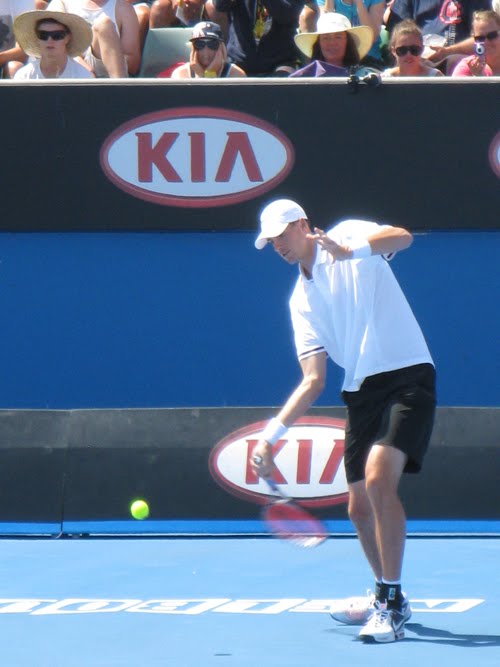 I really enjoyed the first set, but in the second set, Isner smartened up his game, staying back on the baseline more often, and using his big forehand instead, which would be how I’d recommend him to play if I was coaching him. The outcome of the next few sets was heavily dependent on second serves and how frequently they’d need to rely on them, both from Isner and Nalbandian. I don’t think either of them had much success on second serves, but I don’t really know as I don’t have the access to statistics. Isner didn’t really get much of an upper hand in the rallies but he crushed Nalbandian’s second serve, particularly off the forehand.
Nalbandian’s shot selection and accuracy was a pleasure to watch. It was such a contrast to watching Del Potro earlier in the day, where power is first, and accuracy is second (and not always necessary). I love it when every shot he hits is purposeful and deliberate, and it requires a certain mindset and mental attitude that is not always present that day in his matches. Sometimes he only showcases it on big points in matches, but hardly ever on regular points, but here he did on a more regular basis.
On the big points, he’d step it up even more to a whole new level. I don’t remember which set it was. I think it was the second or third set where Nalbandian had to save break points. On the big point, he made every intention of ensuring that every shot he hit was to a safe spot where Isner couldn’t hurt him, to his backhand. He’d give it extra air over the net, to make sure that he wouldn’t miss it, then once when he had the opening, he’d pull the trigger down-the-line or follow it into the net. I thought that was a very interesting lesson on how to play a big point, how to make a calculated risk. Anyone that tells you that it’s all about being brave on a big point is making it sound all too simple. No matter how well Nalbandian is hitting the ball, it looks completely deliberate and smart, rather than just trying to crush a groundstroke. Again, watching Del Potro play earlier made that a bit more obvious than it would have already been.
Nalbandian winning the third set was also due to a slight lapse in concentration from Isner, in the opening game. He missed quite a lot of first serves, and made some ugly errors. The third set was highly competitive, with many closely contested games despite it eventually going to a tie-break. Isner’s serve was amazing in the tie-break. He got a free point off it every single time. Even Nalbandian stepped up his serve in the tie-break as well, getting more first serves in than usual, but Isner had one opportunity and he took it by going after Nalbandian’s serve to take the fourth set.
 Nalbandian bounced back well in the fifth set to play some awesome tennis, the best of the match from him I thought. Knocking groundstrokes into corners and coming into the net to finish it off. Pretty much winning every rally in emphatic fashion. Isner was struggling physically early on, before the adrenaline started kicking in, and Nalbandian should have taken advantage of it. He had played so well, but just couldn’t get that one extra point when he needed it to convert it into a break. Isner continued to pounce on Nalbandian’s second serve. There was one game at 4-3 where Isner had chances to break, due to all those first serves missed, and Nalbandian managed to dig back some very aggressive returns to turn the points into his favour. Some of those break points he saved would have been just as good as the match points he saved against Hewitt last year. That was the point where I thought – it’s the fifth set but Nalbandian is moving better than he ever did to start with. I think because it was an important point, and he didn’t need to conserve energy anymore.
The fifth set started to really stress me out, because despite Nalbandian playing at such a high level early on, all it meant was that the set was building up to be a potential lost opportunity. Not converting on Isner’s physical problems at the start of the fifth set. After the first few games, the adrenaline started kicking in and Isner started moving better, and more importantly serving better. Then he got cramps after Nalbandian’s bathroom break (which I briefly wondered whether it was strategic or not). More evidence there that Nalbandian should be winning, but he wasn’t. Some people in the crowd were cheering for Marcos Baghdatis, during the break, who was meant to be playing afterwards. The longer the match went on, the noisier the crowd got, with shouting out comments and getting involved (the match was already a full house to start with).
After the cramping, Nalbandian started to win most baseline rallies, but as the point got more important, the more effort Isner summoned from within himself to manage to serve an ace. That’s the dangerous thing about cramping opponents. They can appear to be so wounded, but whenever it gets more important, they put in more effort, they get themselves through the pain barrier and run anyway. Isner served the aces when he needed to, and he ran enough when he needed to. He anticipated Nalbandian’s dropshots to break serve to win the match, and he ran far more than he did on a less important point. Those dropshots and lobs might have won Nalbandian the first set, but it was his undoing in the final set.
Nalbandian played all the big points well, but there was one which he choked away at 8-8 on break point. If there was one point I’d look back on, it’d be that one where he set up the point completely in his control, probably thought he would win it about 5 shots in before he even hit the final backhand. He had a crosscourt backhand to get Isner out of position and hit it long by several metres. He eventually got to break point after that, and that was where the drama began of the umpire overruling the service fault and then Nalbandian taking too long, and eventually not being able to challenge it. Regardless of whether that was a poor decision or not, perhaps Nalbandian had it coming to him, with the way he has been treating challenges over the years. Throughout the match, I saw him putting up his finger several times and glancing around, only for it not to end up being a challenge. It’s very confusing. I don’t think it was even necessarily a factor in his loss of serve in the next game. He didn’t play it that horribly – just not strategically well, with those dropshots.
 So that was the end of the match, and there was no way I was staying to watch Marcos Baghdatis without taking a single break or getting out of my seat. Going to the Australian Open by yourself sucks, in that you can’t leave at all for certain matches, otherwise you’ll lose your seat. I already stayed there without leaving for 5 hours or so, so it was definitely time to go home.
Before that, I watched some of Francesca Schiavone’s match against Romini Oprandi, the battle of the Italians. It was nice to see women’s players hitting with topspin, rather than everything so flat and one-dimensional. It is easier to generate angles when hitting with topspin. This could have been better than it was, but Schiavone was shanking her backhand all over the place. She does have a massive windup on the shot, and it looked like it was causing her problems. She hit three shanks to lose the match in the second set.
The first proper match of the day I watched was between Juan Martin Del Potro and Blaz Kavcic. This is the second time now that I’ve watched Del Potro where he’s started off the match by shanking forehands. It seems like it takes him a while to properly warm up on the shot, before finding some form, because of his huge preparation. Del Potro is such a heavyweight. His groundstrokes are so impressive. He thumps every shot, but is it really as impressive as it looks? It’s true that the average groundstroke of Del Potro is better than the average groundstroke of Kavcic, but Del Potro really wasn’t making the best of his ground game here. Instead, he relied on his raw, natural ability to hit the ball hard, and that because his average shot was better than Kavcic’s, he was more likely to win a baseline rally.
 The match in the first set had a familiar feeling to it, the same feeling that I get watching Del Potro on TV, thinking, ‘wow, that was a great shot’, only for the rally to extend so many more shots with more of the same thing. So why is it that Del Potro hits all these great shots, but his opponents get them back, and he has to keep repeating the same thing over and over? It’s a nice display of patience, but he’s not following it up well. Surely he could make use of the net at some stage. I don’t think he made it there at all during the match. Kavcic would have done better if he didn’t double fault so much.
Also, Del Potro’s accuracy seemed to get worse as the match went on. It could be because he made a few too many errors to start with, and became discouraged that his accuracy was very poor in the second set. Kavcic had an early break on Del Potro, but leaked too many errors towards the end of the set. He picked up his game in the second set. I really liked Kavcic’s attitude. He appeared to be completely determined to chase after every shot, and to hang with Del Potro (whereas Nalbandian and Isner were being much more selective about which shots to chase after). In the second set, Kavcic started grunting louder which got many people imitating him and finding it all amusing. It really wasn’t a good match from Del Potro at all. I left after Del Potro took a two sets to love lead, as I really needed to get a break from the heat at some point during the day.


 Posts
Posts


