(This Australian Open blog was posted on Tennis Week here.)
It was the second day at the Australian Open and for the most part, my experience today mainly consisted of watching routine straight set matches, in other words, watching the favorites apply their trade.
I didn’t have Rod Laver Arena access to see the anticipated Hewitt vs Gonzalez match, although I did very briefly see the late stages of the fifth set, where Hewitt broke back to give a brief false sense of hope (and Gonzalez received his medical time-out) before further getting outplayed again to lose the match. Now I would have thought that the whole point of gathering around the big screen was to cheer on the Aussies, yet instead I found the group of Chilean fans sitting right next to me to be far louder in their support. Although it must be said that there are several TV screens located around the venue, so my own experience might not be particularly representative of the entire surroundings.
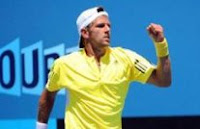
I started off the day session in Court 6 to catch the match between
Jurgen Melzer and
Kei Nishikori, one of my most anticipated matches personally because I actually enjoy watching both players, not just one. As I made my way into the stands, Nishikori had taken an early break lead, so when I started watching was pretty much when Melzer started to take control of the match.
The first set was by far the highlight of the match with Melzer playing at the top of his game, doing all of the dictating and pulling it off. He plays a forward-moving kind of game, looking to take the initiative wherever possible by leaning into the ball and following it up at net. It was an entertaining brand of tennis, although it didn’t seem to be particularly appreciated by the Japanese fans I was surrounded by where those winners were often treated with a silence.
I often get the sense that this kind of play is risky, and watching in the early stages I was wondering whether Melzer even possesses a safe rally shot that can be relied on in longer rallies. That I couldn’t tell is a sign of how often he likes to mix up the play with changes of pace and all other kinds of riskier methods, as well as how well he was playing today.
Nishikori remained relatively passive in the early stages, not making much of a dent in the match, although this seemed magnified by Melzer’s initially aggressive play. Nishikori didn’t seem to be that effortless with his movement and groundstrokes today compared to what I can remember seeing from him previously. This was particularly noticeable in the second and third sets where Nishikori started to attempt to adopt a more aggressive approach, which all it did was make this match an even more comfortable one for Melzer.
Having sensed that Nishikori was struggling, Melzer took the foot off the accelerator in the last two sets, not going for the flashy winners he was earlier but still continuing to play with controlled aggression. For once, he proved to me that he actually is capable of playing with some sort of consistency. Once Nishikori realized that Plan B, the more aggressive tactic didn’t work either then that’s when he got started playing without any real belief. That was also when I decided that the match was not worth watching anymore, although I was only about ten minutes away from its completion when I left.

Then in a completely unplanned move, I walked past Court 3 on my way to check the scores, to notice that
Richard Gasquet had lost the first set against
Diego Junqueira, and was just about to contest the second set tie break. So I went right into the stadium to find out what it was that Gasquet must have been doing wrong to be losing to a player of that calibre. But then as I took a glimpse of that second set tie break, I saw a similar brand of tennis that I usually associate with Gasquet, a nice variety of play and he was quick to come to the net to seize any opportunities that he created. So in short, it was not at all a bad performance from the Frenchman.
At times he struggled with maintaining consistent depth on his groundstrokes, but I have never really found that to be one of Gasquet’s greatest strengths anyway compared to someone like Djokovic who has well-measured groundstrokes. Instead what is most impressive about Gasquet, is how difficult it must be to read and feel comfortable playing against him given that he tends to vary just about everything in his game.
Sometimes he takes the ball on the rise to return serve, while on other occasions he backpedals a couple of steps. He serves-and-volleys on some points, can unleash winners from any position at selective moments and he is excellent at changing the height and trajectory of the ball during rallies. Basically he doesn’t give his opponents any rhythm at all, and I would have to think that playing this kind of game even makes it difficult for himself, not having that clear purpose and strategy to implement again and again.
The match in itself was of a good quality which was evidenced by the high winners count on both ends, which by the end of the match reached a very impressive 76 winners for Gasquet, showing that Junqueira must have played a good match himself. Junqueira is a tricky, slightly unorthodox kind of player. He’s left-handed and likes to generate topspin off both wings, to the point where he gets so much margin over the net. It amazes me his ability to finish off points without needing to flatten out his shots noticeably. Overall he didn’t have that much success on the Gasquet serve and it seemed like he needed to be able to start a point on his own terms to be able to finish it in that same manner.
At times Gasquet would land a ball short near the service line or so, an ineffective forehand whether intentional or not bringing Junqueira into the net only to get passed. In the end, Gasquet’s greater shotmaking ability and ability to remain unfazed and confident over the course of the match got him over the line. Mentally he seemed to be in a very good frame of mind, and I particularly liked his post-match reaction where he seemed to be very delighted with his win.

This is when I made my way into Hisense Arena to go watch yet another Frenchman with flair, the more highly-ranked
Gilles Simon playing against
Pablo Andujar from late in the first set onwards. I noticed on the way there, that on the billboard showing the schedule of Rod Laver Arena matches that they had mistakenly displayed Olivier Rochus’s photo next to Christophe Rochus, an embarrassing error on the organizers' part that was finally rectified later in the day.
For such a one-sided match, I found the Simon match to be a rather entertaining match due to the kind of shots coming off his racquet. But to be fair it also had something to do with a lack of expectation from Andujar, who I consider to be somewhat of a pushover.
The first thing that I noticed about Simon straight away was how it seemed like he generates more pace on the ball live, than it does on TV. He really does have great hands, excellent feel and this was in full display against Andujar.
Simon’s backhand in particular is a very creative and impressive shot. Two things he can do that a lot of other players can’t is to change the direction on a high-bouncing ball to redirect it down-the-line or flick his backhand in any given direction holding it until the last second. Because his backhand is based so much around possessing good feel, he is able to do a lot with the ball even in tricky situations. I noticed on one point, in response to a very deep and penetrating ball, Simon stuck out his racquet face opening it up just in the right angle to reflect it back into its ideal spot, to generate a short angle into the open court.
In the end, it almost seemed a bit like a practice session for Simon, a chance to experiment with playing more adventurously. Whenever he did make any errors, it was usually off the forehand side trying to step up the pace, but who’s going to complain when you win the last two sets 6-1 6-1?
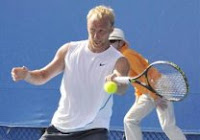
So after the match’s completion, I headed back to the outside courts to watch
Mikhail Youzhny take on
Stefan Koubek. It was a match that promised more than what it actually delivered. It was very much like the Nishikori vs Melzer, in terms of how the match unfolded. The first set being the most closely contested before the overall quality of the match gradually descended as Youzhny lost confidence in his own game.
The start of the match featured long, extended rallies. The goal of both players to hurt their opposition seemed to be the same, to open up the court and put their opponents out of position before hitting the outright winner. The biggest advantage that Koubek seemed to have over Youzhny was his defensive skills and ability to stay in rallies making it incredibly difficult for Youzhny to hit through him. He could also create some good short angles particularly on the forehand side, which of course being left-handed meant that they landed into Youzhny’s backhand corner.
In a typical Youzhny moment, the Russian when holding three consecutive opportunities to break serve at 0-40 started to verbally show his disgust towards himself after making a poor error. Even though he still had two further opportunities to break. In the second and third sets, Youzhny simply got thoroughly outplayed in all areas, not only defensively but also offensively and his game started to look extremely poor.
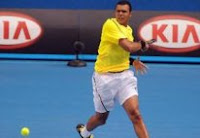
Due to the previous two incredibly one-sided matches, it felt like I was able to witness a large number of matches today. I went back into Hisense Arena to watch the match between
Jo-Wilfried Tsonga and
Juan Monaco. Heading into the event, Tsonga was under an injury cloud so I thought that this might be a potentially difficult banana skin for Tsonga, drawing Monaco who was a solid top 30 player before experiencing numerous health and injury problems last year. This was the kind of match-up where I wanted to see a contest, and all this expectation did was add to the disappointment despite the fact that Tsonga had put in a rather impressive display. The first two games started off promisingly for Monaco, consistently being able to hit well-placed forceful shots and showing the kind of level that forces his opponents to need to play well to beat him. But it turns out that those two games were just about the only two good games that Monaco played all match as it turned out to be a relatively one-sided affair.
The one thing that I noticed about Tsonga was how much reward he seems to be able to get off the forehand, his big weapon. It is such a big shot when he unloads on it that he was often able to virtually win points with one shot, in that it would put him in such a winning position to win the point. Given how impressive players can defend these days, it really is a strong weapon to have. The match mainly seemed to be able Tsonga dominating with the forehand, which he seemed to unload on with more frequency as the match unfolded. Towards the end of the second set is where I decided not to watch the match any longer and instead take a look at
Radek Stepanek playing against
Nicolas Lapentti.

But I found it difficult to get into this match maybe because of the generally quiet atmosphere and surroundings, so I went into Margaret Court Arena to watch one of the most explosive shotmakers on tour,
James Blake play against
Frank Dancevic. It was a very entertaining match which featured superb athleticism and exciting winners. I remember once hearing from commentators that Dancevic’s game is based around pure athleticism and that is one of the first things that stand out about Dancevic. The way he moves around the court is reminiscent of Pat Rafter, who was also known for that, and I particularly liked the way he moved into his one-handed backhand where it sometimes looked like his feet comes off the ground on contact.
Blake’s movement around the court is enjoyable to watch the way he seems to accelerate his movement and move violently into the ball to the point where he would often have to slide in the last second to put the brakes on, to be able to be balanced for the shot. As you would expect in a Blake match, there were also plenty of winners to admire and enjoy. Dancevic himself seemed to be a far more streaky player in comparison, able to string together entertaining shots for brief periods of time but not threatening long enough. From his point of view, the third set was definitely his best period in the match where he played some inspired tennis. But Blake withstood the challenge from Dancevic, sometimes needing to dig himself out of difficult games on his own serve and crucially broke serve at 4-4 to win the match 6-4 in the third set.

 A couple of points into the Eastbourne final between Frank Dancevic and Dmitry Tursunov, and Dancevic looks up for it, ready to give the ball a good crack. Dancevic is one of the flashier players on the tour. When he launches into a shot, he throws all of his body weight into it. It's power, compromising balance. He's running to his backhand corner and he tries to hit a sweeping one-handed drive winner, literally with his legs above ground. I think, sometimes when he's moving, it looks like he's flying around the court, but I can't explain why I think this is the case. To set the record straight, he didn't make that backhand down-the-line and it wasn't even close, but the adrenaline was there.


 Posts
Posts


