Showing posts with label Jurgen Melzer. Show all posts

Thursday, February 10, 2011

Marin Cilic defeats Jurgen Melzer in Rotterdam

I’ve selected a very standard title for my new post and that seems fitting for a match like this. It wasn’t a pretty match, and I can’t remember any memorable rallies. But in the end, Marin Cilic was the more solid player and defeated Jurgen Melzer 6-2 6-4.

Cilic hasn’t had a good last 12 months after a maiden semi-final appearance at the Australian Open last year and cracking the top 10. He was also awful against Florian Mayer last week. Keeping in mind that I would possibly do a piece on him after this match, I took a closer look at his overall game.

Outwardly it looked similar to the way it always did, except a more unspectacular version of it. The same kind of low intensity game based on ball-striking and accuracy (though not so much on accuracy anymore). He was particularly passive to begin with, mainly focusing on getting the ball into the court. It took a while before he took it up another notch, taking the ball earlier on some of the shorter balls and hitting with better depth. It was good that he did that on occasion otherwise I would have thought he was warming up.

He comes across as so workmanlike that I’m not even sure if he likes playing tennis. I just assume he does, because he made it this far and apparently players in Croatia are harder working than the Brits for example because they had a tougher time growing up. That means there is more benefit for them to be successful.

His game was always lacking spark though. He’d change directions so smoothly that it just looked like he was casually rallying with his opponent. He relied so much on timing. His winners don’t catch the eye as much as Melzer’s winners do on a better day. You have to look closer. Melzer had some eye-catching errors today though. This season, he’s been confidently swinging away on his groundstrokes regardless of whether he’s been playing well or not. He’s been making a lot of rash errors. He hit a forehand that was out wide today by the equivalent of half the width of the court, timed in the middle of the strings. I suppose that’s proof he was trying to hit all kinds of shots that he wasn’t prepared for, in terms of footwork.

Anyway, it just wasn’t Melzer’s day. He didn’t have much success returning Cilic’s serve and he tried to improve his consistency in the second set, but it still wasn’t good enough. He takes big swings at the ball especially on the forehand, and he’s known more for his explosiveness than accuracy. Going up 0-30 at 3-3 on Cilic’s serve ended up being more of a mental hindrance. It was a huge disappointment for him even though he didn’t really do anything special to go up 0-30, so it wasn’t like a drop in level. He smashed a racquet once it got back to 30-30, then began to shout at himself almost every point from then onwards, and gave a sarcastic clap at the changeovers.

He was probably already in a bad mood to begin with though. The match had barely started and Melzer asked the umpire a couple of times to get the people to talk more quietly, especially those sitting near the court. A quick camera shot of the stadium shows that the stadium was reasonably empty. Melzer is known for finding every little thing that goes on externally annoying.

Sometimes Cilic’s calm approach gives him a disadvantage against more inspired players, but today it was surely the better approach. Some might say it is just a personality difference, but I’m pretty sure that playing with a relaxed demeanor would affect the way you move around the court, and the energy around the footwork as well. Then again, to put in a more simplistic manner, he was the more solid of the two players and was subsequently rewarded. He also won plenty of free points on his serve.

Wednesday, January 19, 2011

Australian Open 2011 - Day 2 Blog

For the most part, whenever I make it to Melbourne Park, I try my hardest to spend as much time watching whatever match I want, rather than the match before the one I want to watch. But the usual plan isn’t working as well as it used to, yet I sometimes still feel stubborn about watching other matches beforehand.

In any case, Anna Chakvetadze was serving for the match at 5-2 in the second set, so there wasn’t that much to wait for, before Jurgen Melzer’s match against Vincent Millot would start. Ordinarily you would think there is not much to write about three games in a match, but it was highly amusing. Chakvetadze choked a bit, but ended up digging herself out of break points to finish it off 6-4 in the second set, and she sure made an internal drama out of it.

Chakvetadze basically threw away her first service game serving for it, with four horrible errors in a row. Her attempt at breaking was slightly better. At least she won some points in it. Almost every time she’d win a point, she’d pump her first, trying to prove to herself that she has determination and that she can fight through it. Usually fist pumps are a positive form of emotion, confident approval of whatever happened in the previous point. But every fist pump that came from Chakvetadze were off Govortsova’s errors, but Govortsova should have been pleased anyway that Chakvetadze seemed this insecure about herself.

It was only until Chakvetadze found herself down break points for the match to level up, that she started to play better. Playing better, because she felt like she was behind. Then finally, Chakvetadze earned herself a real point to celebrate, with a great down-the-line winner from what I could recall, and with the help of some errors from her opponent, she closed out the match.

That was a good little piece of drama and fortunately brief, because it can get depressing watching a trainwreck.


Jurgen Melzer’s match against Vincent Millot sure could have used some drama or intensity. Millot made it into the main draw from qualifying, and he was completely outplayed by Melzer in every department. He’s a short, left-handed player and reminds me a bit of Wayne Odesnik, especially on the forehand side where they both hit a relatively loopy shot with high margin over the net. The problem was that he was neither consistent or a good shotmaker, so he was often overpowered by Melzer, and he didn’t put him under much pressure either by making many errors.

Melzer seemed to be able to hit many winners, or unreturnable shots with ease, often coming out of nowhere. It wasn’t like he moved the ball around that much, before unleashing the winner. I guess that shows how much pace Melzer can hit the ball with, but he was also patient rallying.

This match was incredibly one-sided though, so I was feeling kind of bored watching it. Coming from court 7, there was a lot of cheering and noise, but coming from the surrounding courts instead rubbing in that feeling that there were better things going on elsewhere. Even in that 6-4 second set, Melzer was up a break, then lost it, then broke again. I left after the second set realizing it would probably reach its expected conclusion.

I tried to head down to watch David Ferrer against Jarkko Nieminen, until finding out that seats were full. I think many of them were part of the Greek contingent waiting for Baghdatis’ match afterwards.


So I went in to watch Juan Martin Del Potro’s match against Dudi Sela instead, starting right from the beginning. Players had not yet come onto court when I arrived, otherwise it would have been more difficult to find seats once the match had started.

Listening to the pre-match cheering, it looks like both players have their fair share of vocal supporters, but Sela has more. To begin with, this match featured an entertaining contrast of styles. The match-up between Del Potro’s power and shotmaking ability with Sela’s counterpunching ability and ability to move the ball around the court. One has a lot of power, while the other doesn’t.

In the early stages, Del Potro approached the match, by trying to play solid and consistently with changes of pace on the forehand. In my opinion, changes of pace is something that is much more obvious live, than on TV, and also one of my favourite things to watch live because of that reason. To see how players can catch their opponents off-guard and find winners much more easily by surprising their opponents with more pace than usual. It’s also good percentage tennis, to not hit everything at a fast pace though.

Del Potro played well to start with in the first half of the set leading 4-2, but then his game suddenly went downhill. The biggest problem by far since his comeback has been his forehand which he has been shanking and hitting all over the place at times. He pretty much threw away his service break with bad errors, but after that, the poor form continued with flashes of good shots.

Still, there were plenty of long rallies and the first set was quite entertaining. I really enjoy watching Sela’s accuracy and all-court game. He has a very smooth way of playing, but in this match, it was always evident from the start, that if Del Potro could keep his errors down, he could dominate the rallies.

The highlight and climax of the match, at least based on what I watched was the first set tie-break which Del Potro ended up winning 15-13. The tie-break had everything in it. Good shotmaking, missed opportunities, bad errors, big serving and many hard-fought points. When I saw Sela in Brisbane, I thought he played well for two sets except when it really mattered. The same ended up being true here. He had a forehand putaway off a short ball to win the set, and he shanked it. Then he followed it up with another bad error in the tie-break.

Del Potro had his own demons to battle as well, missing one easy shot on set point too, from what I could remember in that set. But Del Potro also came up with so many clutch serves throughout the set, that his play on big points also saved him many times. It’s hard to believe that Del Potro’s serve was often criticised as being poor when he first burst out onto the professional tour. A lot has changed since then, and it has easily been his best shot since his comeback from injury.

Long and dramatic sets seem to often end up in an emotional letdown, even if not from the players, but from the crowd. Or at least usually from me. Having watched that tie-break, everything early in the second set, immediately seemed much more boring. But it seemed like the momentum from the first set had carried on, and Del Potro started to play more confidently now, while Sela was nowhere near as consistent as he was in the first set. Definitely Del Potro was playing much better tennis from then onwards.

In the first set, Del Potro finished up with approximately double the amount of unforced errors as Sela. But the second and third set statistics must have surely been very different.


It became quite one-sided, so I decided to leave the match to watch Radek Stepanek’s match against Denis Gremelmayr.

While the match was going on, there was some very loud cheering going on nearby, people chanting and cheering for Guillermo Garcia-Lopez, not exactly a player you’d expect to receive that kind of attention. It was loud enough that it sounded like it was coming from the same court, except often while the points were being played too. Still, being scheduled on a court like that usually comes with background noise.

The scoreboard on this court hadn’t been working for a while, so it was stuck on 0-0 for a set and a half all over the grounds which must have been highly confusing. I didn’t miss out on much though, and they were at 3-2 when I arrived. Even though this was a one-sided match, this was better than the other one-sided matches. It was Stepanek in full flow, the master tactician. His shot selection, accuracy and all-court game is great to watch. But I think none of that would have been possible without his excellent ability to change directions on the ball, often hitting effective down-the-line shots, sometimes with slice and sometimes with topspin.

The match was one-sided enough, that I didn’t really pay close attention or judge Stepanek harshly if he made a few too many errors. He was in full control of this anyway. I was more looking at the shots, rather than the story.

Strangely enough, I don’t think I’ve seen Gremelmayr play before. He has an odd lefty forehand with a very abrupt circular motion. Both his weapon and his weakness, I assume. He strung together a couple of good forehands to get back even on serve in the third set, but then Stepanek broke right back to take the match.


While this match was going on, Robin Soderling blasted through his opponent in quick time, so there was a half hour gap before Jo-Wilfried Tsonga’s match with Philipp Petzschner. During the break, spectators were amusing themselves by hitting beach balls around the stadium. At first I didn’t see it, and didn’t know what all the cheering and booing was about, but they started booing when the ball fell onto the court. Then the Mexican wave started, a key feature of every Margaret Court Arena night match.

In the end, I didn’t end up seeing much of this match due to Kim Clijsters’ double bagel of Dinara Safina, but also because they had an epic game at 1-1. Petzschner had 7 break points in that game, but wasn’t able to convert. Once it was 2-1 on the scoreboard, Clijsters had already rolled through the first set.

It was a shame though, because it was quite an entertaining match, but also slightly inconsistent. A battle of two flashy players with big forehands, where style comes before tactics and grinding. Basically Tsonga and Petzschner try to win matches the way they want to, and if it’s not working, then they try harder to play better while playing similarly. There were a lot of forehand to forehand rallies, with both players using the angles, not exactly your typical match. Matches seem to revolve more around backhands as the rallying stroke these days, while players are more likely to change directions on the forehand side after a while.

Petzschner nearly went down an early break in the first set, with his forehand badly misfiring but it didn’t take him long to pick it up on that side. From then on, it was a mixture of flashy shotmaking and errors, but it was fast-paced enough that it was entertaining anyway. It’s surprising that the match went five sets though, with Petzschner taking a two sets to love lead, then Tsonga coming back in five.

The Rod Laver Arena night match between David Nalbandian and Lleyton Hewitt, was a whole new experience in itself, completely separate from everything, and the most memorable match I’ve seen live. It was a match that deserves its own report, and you will find it here.

Wednesday, January 20, 2010

Australian Open Day 2 Blog

Tomas Berdych has been in good form recently, or at least in patches. He's commonly known for his smooth ballstriking, and I’ve recently come to appreciate that more after some high quality performances in Brisbane a couple of weeks ago.
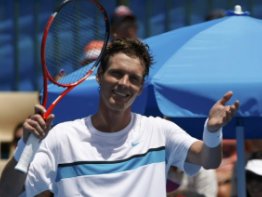
When he’s on, it looks like he has more feel for the ball than the majority of players with the way he’ll casually just put every ball into the corner, because why not when it’s this easy?

Berdych was pitted up against Robin Haase and he picked up right where he left off in Brisbane. Although he really didn’t, because in between, he had a strange loss to Peter Luczak in Sydney.

When Berdych plays like this, it looks rhythmic like he has gotten himself into a nice groove in the same way that a dancer would be moving to the beat of music. I can see why commentators mention that Berdych only does things one way, and that’s making everything look pretty, not dirty. Even when he lunges out to reach a ball, he doesn’t look fully extended. It’s like his long limbs are doing the job for him, though that obviously isn’t the case.

But Grand Slams are made of best of five set matches, so it was never likely that he’d be able to put in a consistently perfect performance. I tried to enjoy it while it lasted, the first set of the match. Haase tried to keep up, but it never looked like he could get to the ball quickly enough to hit an effective defensive shot.

He seemed intimidated at first by Berdych’s quick start but he settled down early in the second set, helped by a very loose service game from Berdych. That service game didn't eventuate in a break, but it changed the course of the match. This was always in the cards for Berdych, who generally plays significantly worse even at a 5% lower level. The second and third sets showed Berdych playing at a more neutral level until picking it up again late in the third, where he started to put Haase back on a string again.

That’s what Berdych generally likes to do, make his opponents cover large distances. Not much else comes into consideration such as whether making that risk would be necessary. Tennis is an instinctive game for Berdych, and it looks like he’d like to keep it that way. The first set was somewhat exhibition-like in its execution, not that I had a problem with that.

I have to give credit to Haase though, who tried his best to turn the tables around. He’d put in a special effort to take the ball earlier and control the match with his forehand. This was a difficult task in itself, because Haase's forehand has a significantly greater margin over the net than Berdych’s, so it's easier to retrieve.

Comparing effort levels, it was like Berdych barely broke a sweat while Haase needed to give his full undivided attention and intensity in order to play tennis like this. Therefore it was no surprise whenever he’d throw in a disappointing error, he’d shout at himself in frustration. It’s a lot he has to manage out there, not only his game. He kept it together today, but not well enough. Not well enough for a top class player like Berdych.

Near the end of the match, in what was the best point of the match, Berdych had sent Haase running side-to-side all over the court almost in a Davydenko-like manner, doing everything but missing the delicate drop volley into the open court. As amusing and meaningless it all was in the context of the match, is this a typical Berdych point from a more general perspective?


In what seemed like relatively good timing, I was able to watch the conclusion of the Fabrice Santoro vs Marin Cilic match, which I thought might have been finished last night. Things picked up right where they left off stylistically anyway. Both Santoro and Cilic must have been quite pleased that far more people were watching them this time around, and in a much more enthusiastic manner too.

There’s not much to mention about Cilic in this match-up. He approached this the same way as many of the other top players have done in the past against Santoro, and that’s to play with patience. The point was not how many unforced errors he made, but whether he could keep a calm head and avoid overplaying, then he'd fancy his chances to win the match.
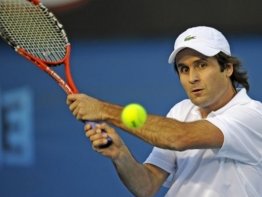
This is where Santoro looks a bit lightweight. Maybe in a dream world, it would be really cool if Santoro could hit chip shots like he currently does now, while being able to drive through the ball with more pace too, to drive opponents crazy with changes of pace. But I guess anyone that wants to see that will have to stick with Andy Murray for now. Then again that would probably take away all the admiration and amazement that tennis fans have for Santoro, how he has managed to make it this far in the tennis world with not only such an unorthodox game, but with such a lack of pace.

The problem with Santoro’s drive shots was mainly the depth, not the pace. It would land short too often and Cilic would take advantage of that with more net approaches than we usually see from him.

Still, he managed to show a nice mixture of play to keep the match interesting with net charges, slow probing slices and some lobs. One thing that I forgot to mention, or failed to notice yesterday in my report about Santoro, is how difficult must it surely be to bend down as low as that to hit low volleys with two hands. I wonder why he doesn't switch to a one-hander on the stretch but he never does unless he absolutely needs to.


The way the scheduling and timing worked out, this allowed me to watch the match between Jurgen Melzer and Florent Serra, right from 0-0. This match was played on Court 11, right in the middle of numerous outside courts. It’s basically the most distracting court in Melbourne Park, though I still think this is a fair deal considering that it’s not like players have to deal with any music or outside entertainment.

In my line of sight, I had the additional light entertainment of being able to see Tommy Robredo and Santiago Giraldo swing through their groundstrokes without having a clue where their shots were landing.
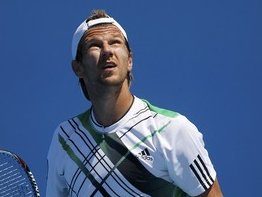
Melzer didn’t seem to like the atmosphere much though. I was amazed that every noticeable distraction, such as the umpire reading the score from a nearby court, a sudden cheer or someone walking into the stands mid-match, he’d notice it to the point of even stopping play because of it. It’s just that you would think that if everything was noisy and chaotic, that little things like people walking across the stands would mean little in comparison.

The way the stands on Court 11 are built, one side doesn't even have an entrance meaning you can just walk past and sit down straight away. Yet on the other side of the court, we’re practicing normal tennis rules here. I did think it was incredibly amusing though whenever the chair umpire would remind people to not come in until changeovers, as if the people sitting down were the same people who had not yet arrived.

As for the match itself, it was a bit of a grower. Early on, this definitely seemed like a lower standard of tennis than what I had been watching before. Whenever they were a little off their timing, the ball would fly on them. At least Serra was cracking his forehand though, so that made a big difference in dictating the match. The first set was more like a sub-plot in itself, separated from the rest because Melzer picked up his play after that.

The second and third sets were played at a whole new intensity, with rallies that were physically challenging and difficult to keep up with. Suddenly everything seemed to be moving at a faster pace, and sometimes I became fixated with watching the ball move back and forth, the ball being hit with such skill, noticing little angles here and there and down the line shots. Things like that are generally more interesting at this close side-on view. Melzer has a better ability to include subtle variety in his game, throwing in a double-handed slice backhand and a decent transition game which he used more sparingly than he normally does.
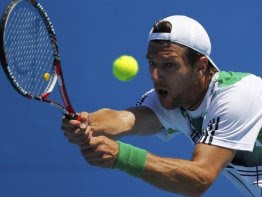
I really liked Melzer’s fighting spirit here, how he went from being dominated in the first set, to being able to dig deep enough to hold his own ground in the baseline rallies and slowly outmaneuvering Serra. Watching the match unfold, I could feel as if Melzer was increasingly starting to take over more control in the match. The third set was the critical stage, the one where he continually had more chances to break serve, only to lose his serve in the final game which was outlined by a potentially bad line call.

I took a short break after the end of the third set to prepare for the rest of the match, and this helped emphasise how the last two sets were so much different from the second and third. It must have been all that intensity from the earlier sets being so hard to keep up, that it became very patchy towards the end.

Somehow after all of that effort, Melzer snatched the fourth set rather tamely. By now, Serra had decided to hit the ball harder, though it seemed clear that Melzer was no longer chasing down balls as quickly as he was earlier. He has a reputation of this, of slowing down and becoming fatigued in the fifth set, and this is what happened here. Just like how he had resigned to the loss, I had too. It was a long match to follow, but I did it.


After watching an intense competitive match, it was refreshing to watch a more straightforward match storyline-wise, as I diverted my attention to Jo-Wilfried Tsonga’s match against Sergiy Stakhovsky. I thought for a moment with Stakhovsky going up a break in the second, that maybe it would be competitive. But as soon as I sat down in the arena after Tsonga broke back immediately, he never looked threatened.
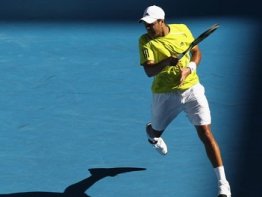
It’s been a year now since I had seen Tsonga live, and straight away he reminded me again why he’s one of the most fun players to watch. Sometimes tennis can have a tendency of looking overly technical live but not for Tsonga. Tsonga’s game just stands out. He hits a couple of forehands, leans right into them, then he comes in to knock it off for a volley. Or at least that’s how he would like to play, by having as few in-between shots as possible.

He was able to do that at first, but after a while, he started to engage in more rallies with Stakhovsky and that’s when you start to see his range of higher looping balls too. I don’t think they’re a strength of his, but at least he covers the court well.

Stakhovsky’s game isn’t too dissimilar from Tsonga’s actually. He likes coming into the net and playing an all-court game, and he doesn’t hang around too long at the baseline. That’s why this match was being played at an extremely quick pace. He plays aggressively from the back of the court too, sometimes to his detriment because of his inconsistency.

Aesthetically it doesn't share many similarities to Tsonga though and his moves from the baseline to the net are nowhere near as smooth. His mannerisms especially when returning serve reminded me so much of Philipp Kohlschreiber, and his backhand is a little similar too, maybe more so just because I have already linked them together in my head.

It should be interesting to see over the coming years what Stakhovsky can add to his game, because it looked promising but rough to me. Like he seemed to be developing a good idea of how he should be playing but without pulling it off well enough. In the end, he was comfortably outplayed by Tsonga, who showed positive signs but will need to tighten up the screws over the coming days to avoid any potential difficulties.


In any case, that match was a nice short break from drama because I was in for another hotly contested match, this time between Richard Gasquet and Mikhail Youzhny. This was my first experience watching a late night match that ended up being extended late into the night, and I had a lot of trouble with it, clock-watching all the time to make sure I wouldn’t be back too late, whatever that meant.

This was a high quality match though, definitely the best match I’d seen so far. What I liked about it the most was not only the variety of both players, but the variety of shot selections from point to point. I think the best way of analysing whether a match has long lasting appeal, whether it will continue to be entertaining three hours onwards, is whether the pattern of play is predictable or not. Whether each point is played out a different way, involving different strategies, and not seeing similar contrasts again and again.
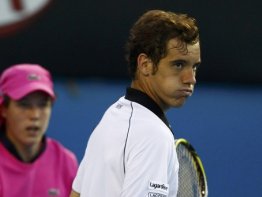
Youzhny opened up the match looking shaky and lost his opening service game. Gasquet seemed much more calm and controlled in comparison, an indication of all the tennis he’s played leading up to this event. From the view I’m looking at, at first it’s difficult to adjust to seeing the spins so clearly from the players, almost to the point where it looks like every shot is a safe shot because of the margin over the net.

Gasquet started to impose himself on the match quickly already with his trademark backhand, opening the match with some smart tennis while Youzhny was still finding his range. Soon enough though, Youzhny regained his consistency and they were back on serve in the first set.

There wasn't much separating the two quality-wise. Youzhny is great at creating clever rallies and opening up the court, while Gasquet is better at utilising his transition game and playing a more outright attacking, but straightforward game. This was always an entertaining match-up on paper because despite both players having great backhands, they were never going to be overly reliant on one shot or tactic.

I had the feeling initially that Gasquet had the upper hand because he had the ability to be more attacking and finish rallies in fewer strokes with his net ability. Yet Gasquet never really pulled away from the match that much, even though he threatened to several times. He snatched the first set on the back of a nervy tie-breaker from both players that was full of poor errors and double faults towards the end. It was great drama though, and the crowd reacting and making sounds during good points definitely added to that.

In the second set, Gasquet started to play more of a baseline oriented game. He appeared to be carrying a niggling injury in the beginning of the third set, then twitched his face to show he was in some pain, then switched his tactics back to play more aggressively again as a result. This was definitely the right way to go, and it helped him take the second set without the need of a tie-breaker.

The longer the match went on, the more enthusiastically I started to cheer for Gasquet hoping that it wouldn’t go too late in the night. But he continually refused to finish off the match. More accurately, he couldn’t finish off the match. I could tell Youzhny was getting stronger and stronger as the match went on. His forehand started to become much more of a weapon, whereas before he was guiding it to its spots. Then he also took some advice from Gasquet, and started shortening the points and coming into the net with far more frequency.

I think mostly, it just seemed that Youzhny had been re-energised. He started to look much more alert controlling the points more too. It all started from the third set tie-break, which also contained good serving from him. But his form continued to fluctuate in the fourth set, down an early break and down a match point in the fourth set, but Gasquet let Youzhny off the hook by playing far too passively.. Though when Youzhny played well in that set, he was brilliant.

Just as I happened to be mentally preparing for my exit, the fourth set finished in the best possible way I could have imagined. With both players running all over the court and Youzhny ending it with a backhand down-the-line winner that looked like a backhand crosscourt winner, based on how far Youzhny was out of court.

That was the shot that ignited the stadium, not that they weren’t already into it and Youzhny celebrated it in a way that a shot and point like that deserved to be celebrated. Gasquet realized the job that was ahead of him now and hit a ball out of the stands of Margaret Court Arena. At first I thought this was a terrible way to leave a match, but no, it was perfect and it provided some closure in the same way that a TV show cliffhanger does.

Saturday, September 5, 2009

US Open Day 5: Del Potro defeats Melzer to safely navigate into the 3rd Round

One thing that separates the top players from the rest of the pack is their technical ability, their ability to safely rally from the back of the court reliably, while naturally having good penetration on their shots. It's having a good solid base to build the rest of the game from, and when you feel you've got that, it becomes a whole lot easier to execute the more difficult shots and the tactical side of things.

When it comes to technically sound groundstrokes, Juan Martin Del Potro would have to be right up there with the best. On the basis of this, he always had the upper hand against Jurgen Melzer in his second round match. It's always a worrying match-up when it looks like one player doesn't really need to do anything to win, and that's what it was like for Del Potro. He can pretty much just rely on what is already naturally there, the power, the mechanics of the shot.

To break out of that pattern, Melzer really needed to come up with something special, anything to disrupt the flow of play, to not allow Del Potro to hit his shots. Melzer's strength isn't in long rallies anyway, and this is what he specialises in. He might exchange a couple of shots relaxed from the baseline, but his shot tolerance isn't high. At some point he'll want to step in and rip a shot, taking the ball as early as possible and changing the pace.

I thought early on that maybe this is not such a bad match-up for Melzer, when comparing top players he'd rather play against anyway. If you're going to take advantage of Del Potro's slight weakness in movement, it's best to do it early in the rally and Melzer is certainly capable of doing that. That is: taking the ball early and approaching the net, which he did with good shot selection.

I noticed that almost every time Melzer came into the net, he had a good hit at the ball, a sign of good approach shots and net coverage. Del Potro even if he won points could rarely hit a clean pass through Melzer. He also threw in some double-handed backhand dropshots for good measure which worked well for the most part, his self-confessed favourite shot.

The problem for Melzer though was the ongoing pressure of executing with consistency because he doesn't have that solid base he can fall back on. It's so easy for him to snatch on a shot he's trying to take early, and surely on some points he feels the pressure of having to end the rally to avoid hanging around in long rallies.

Melzer is a player that has excellent feel on the ball, particularly in terms of finesse and variety, capable of playing aesthetically pleasing points but also capable of missing the easiest of shots, particularly under pressure. It became an ongoing theme, Melzer putting himself in winning positions to finish points then missing the most routine of shots right at the end.

The first crucial point that cost Melzer was the way in which he conceded his break of serve at 3-1 up, in a game where he missed an overhead smash into the open court on a point which would have won him the game. It was unexpected because up until that point it was the best service game that Melzer had played in the match, finally a game where he didn't have to fight through multiple break points to hold.

The next crucial stage was the first set tie-break, which seemed to be in Melzer's pocket all along until near the end. Frankly it was a set that Melzer should have taken advantage of, given how poorly Del Potro played in the first three points with wild groundstroke errors. But instead, he slowly threw away his lead with a double fault, then after a perfectly constructed point, getting carried away and running too close to the net and bouncing a smash right into the service box only to get lobbed by Del Potro.

By then, Del Potro had found the range on his serve, winning a couple of points with unreturnable serves. Melzer doesn't exactly have the same luxury on his serve, but he hit quite a good serve set point down but missed the forehand down-the-line follow-up shot. What a microcosm of how the whole set had panned out.

I would have thought at some point that Del Potro would raise his game, or at least attempt to, but he stuck with the mechanical game of the first set. I mean, pretty much every shot he hit was aimed close to the middle of the court but he can get away with it to some extent because he has more natural penetration and power than most players, and he's also consistent. Not to mention that he can rely on his serve, to maintain a certain level. Unfortunately Melzer's game slowly began to decline in the second set, with more errors flying out of his racquet so it all started to look routine.

I wouldn't read much into Del Potro's performance in this match. Maybe what is equally important is how calm he remained the whole match, aside from the couple of errors in the opening of the first set tie-break. The thought never even entered his mind that he might struggle in this match.

My stream stopped working in the third set, but when I turned it back on halfway through, the commentators mentioned that Melzer had cleaned up his game. But when I switched it back on, it started to look a lot like how he lost the second set with inopportune errors and Del Potro served out the match for a relatively comfortable victory.

Friday, January 23, 2009

Australian Open Day 4 Blog

(This Australian Open blog was posted on Tennis Week here.)

Today was a day that featured a mixed quality of matches, one that I considered to be a disappointing day of tennis until later in the day when I witnessed the match between Jo-Wilfried Tsonga and Ivan Ljubicic which was easily the best match that I’ve seen so far this Australian Open.

Jurgen Melzer, hitting a backhand against Andreas Beck at the Australian Open

I started off the day over in Court 6 to watch Jurgen Melzer play against Andreas Beck. Beck is a player that I knew little about, but as soon as the match began in progress, it looked like I had underestimated him as he got off to a quick start. It didn’t take long for me to change my mind about him, and I soon decided that he was a dangerous kind of player.

He’s got flat groundstrokes off both sides, particularly off the forehand side and generates some good pace on it. He surprised me numerous times in the beginning how Melzer would be trying to build up a rally with slice backhands and keeping relatively good depth but Beck would just ignore it and go right ahead with trying to blast a winner quickly to end the point. And so it worked for a while, but with shots as flat as that, it was inevitable that he was going to throw in some poor service games as well. So the key for Beck was to try to get the most out of his serve, and he won a lot of points early on with fast, deep serving, although its accuracy in terms of its width was hardly impressive.

Melzer soon started to realize what Beck was doing himself and suitably adjusted his game, to start to play more first-strike tennis, following up shots better on his own serve and adopting a more aggressive game himself. Incidentally the game he was starting to play was a very similar style to Beck’s, so it was like trying to beat him at his own game. Implementing the big, flat shots and following them into the net. Except that Melzer clearly has more flair than Beck and can implement a greater variety of play especially on defense.

The big problem about this match was the inconsistency of both players and the outcome of the match being overly reliant on simply who could execute their game better. Both players were capable of playing consecutively poor points and they often made too many errors off the follow-up shot, the shot straight after the serve which should be a relatively easy putaway shot at times. So in short, it was a match that featured flashes of brilliance, but not at a regular rate.

What was most engaging about the match was the sheer unpredictability of the match and the closely contested nature for the first three sets, which is why I lost interest as soon as Melzer had taken the lead in the fourth set. Beck had his chances to take a two sets to love lead after leading in the second set tie-break, but that was when the momentum switched to Melzer who ended up winning the fourth set comfortably 6-2 to take the match.

I had contemplated at the time as to whether I should have searched for another match to watch but I was simply not interested in watching only one set of tennis. The live scores suggested that most of the men’s matches at the time were already near their closing stages into potentially the final third set, when the outcome of the match itself was not in doubt.

Gael Monfils at the Australian Open

So I walked over to Hisense Arena to watch the match between Gael Monfils and Stefan Koubek, a match which in hindsight was maybe a poor choice as I found myself completely restless and bored. It was a match-up issue that I could not have foreseen myself giving the impression that Monfils was in utter control and that there was little that Koubek could do about it. Playing against someone like Monfils really emphasises Koubek’s limitations in his offensive play, his inability to hit winners when not given pace or angle to work with.

At first I could see that Koubek was doing well in using the full dimensions of the court to patiently move around Monfils. Monfils started off slowly himself, so the start of the match was slow paced, compared to what I’m usually used to watching. But as soon as Monfils started to implement more changes of pace on the forehand and backhand sides, which occurred with more frequency as the match went on, Koubek could no longer match him. Midway in the first set was when Monfils converted his first break of serve.

To make matters worse, Koubek knowing what he was up against would try to implement some more aggressive play which just often led to tame errors on his side. Having Monfils, primarily a defensive player play against someone like Koubek does not bring the best out of him, in terms of the spectacle, and subsequently Monfils wasn’t particularly animated either. In terms of the match, it’s good for him because he’s better in all departments but he isn’t given the opportunity to hit those amazing shots on the stretch. In fact, because Koubek plays a slow-burning kind of game, he never even looked like he had to show exceptional movement around the court.

Even though Koubek had gone up an early break in the third set, it definitely looked like nothing more than a lapse of concentration from Monfils, and so I continued to be bored. Then in one of the changeovers, the live scoring popped up for Court 13. Radek Stepanek had taken the first two sets comfortably but Michael Berrer had won the third and was up a break in the fourth. I was originally reluctant on it given the distance between Hisense Arena and most of the other showcourts, especially if I was planning on coming back relatively soon for the following match, but I rushed over there anyway.

Radek Stepanek in action against Michael Berrer at the Australian Open

Could this be an exciting five-setter? We all know that five-set matches generally tend to have a much better atmosphere surrounding them, and that was evident straight away as I sat down to watch Berrer serve for the fourth set. But from then on, is where Berrer barely won any points at all getting broken twice comfortably to lose the match 7-5 in the fourth set, but at least I experienced a brief moment of excitement.

From where I was sitting, I was surrounded with people shouting out German comments to Berrer, and maybe some Czech thrown in there as well, if I knew what Czech sounded like. I liked how the tension and drama in the match was particularly emphasised by the loud grunting of both players after they hit a shot. At one point, Stepanek did a fist pump in Berrer’s face which drew a smile out of Berrer, an interesting and refreshing reaction I thought. Stepanek hit quite a few dropshots and touch shots which are the kind of shots that I like to see him play and when I find him to be most enjoyable. It looked like it was some good all-court tennis from both, although I definitely shouldn’t be judging given how little I watched.

Ivan Ljubicic in action against Jo-Wilfried Tsonga at the Australian Open

In some ways it turned out well that it didn’t go to five sets because that meant that I was able to watch the match between Jo-Wilfried Tsonga and Ivan Ljubicic right from the beginning, and what a match it was. It was high quality tennis from both ends, aggressive tennis from both sides while keeping the errors down.

Ljubicic’s groundstrokes look better in real life than they do on TV, more penetrating than it looks and he gets quite a bit of work on the ball. This must have been the best match he has played in a while, at a similar level to when he was at his peak around 2006. His forehand in recent years had been a declining and error-prone shot and early on, I was expecting him to make some tame errors on it but it held up well for the majority of the match, a sign of how well he was playing.

What I like most about Ljubicic’s game is the variety of his game, which didn’t allow Tsonga to take control of the match. He made good use of the slice backhand in particular to mix up the play which allowed him to stay in rallies and turn defense into offense on a number of occasions. Not allowing Tsonga to take control with a single forehand, which I mentioned earlier as one of his strengths, and also implementing a nice all-court game.

It was a display of good shotmaking from both sides, and that Ljubicic was able to generate almost as many winners as Tsonga, one of the most explosive shotmakers on tour was yet another sign of his good form. I liked in particular how both players were able to elevate their games even further under pressure, especially in the tie-breaks.

The atmosphere was electric in Hisense Arena, with the crowd sensing that maybe Tsonga needed some help. Ljubicic must have been devastated in the third set tie-break, how he did everything right on his end to take a 6-3 lead, only for Tsonga to elevate his game to amazing heights to make a comeback and take the third set. Then Tsonga ran away with the fourth set, hitting aggressive returns and passing shots, helped by the declining quality of the Ljubicic serve.

Wednesday, January 21, 2009

Australian Open Day 2 Blog

(This Australian Open blog was posted on Tennis Week here.)

It was the second day at the Australian Open and for the most part, my experience today mainly consisted of watching routine straight set matches, in other words, watching the favorites apply their trade.

I didn’t have Rod Laver Arena access to see the anticipated Hewitt vs Gonzalez match, although I did very briefly see the late stages of the fifth set, where Hewitt broke back to give a brief false sense of hope (and Gonzalez received his medical time-out) before further getting outplayed again to lose the match. Now I would have thought that the whole point of gathering around the big screen was to cheer on the Aussies, yet instead I found the group of Chilean fans sitting right next to me to be far louder in their support. Although it must be said that there are several TV screens located around the venue, so my own experience might not be particularly representative of the entire surroundings.

Jurgen Melzer, pumping his fist in a win over Kei Nishikori at the Australian Open

I started off the day session in Court 6 to catch the match between Jurgen Melzer and Kei Nishikori, one of my most anticipated matches personally because I actually enjoy watching both players, not just one. As I made my way into the stands, Nishikori had taken an early break lead, so when I started watching was pretty much when Melzer started to take control of the match.

The first set was by far the highlight of the match with Melzer playing at the top of his game, doing all of the dictating and pulling it off. He plays a forward-moving kind of game, looking to take the initiative wherever possible by leaning into the ball and following it up at net. It was an entertaining brand of tennis, although it didn’t seem to be particularly appreciated by the Japanese fans I was surrounded by where those winners were often treated with a silence.

I often get the sense that this kind of play is risky, and watching in the early stages I was wondering whether Melzer even possesses a safe rally shot that can be relied on in longer rallies. That I couldn’t tell is a sign of how often he likes to mix up the play with changes of pace and all other kinds of riskier methods, as well as how well he was playing today.

Nishikori remained relatively passive in the early stages, not making much of a dent in the match, although this seemed magnified by Melzer’s initially aggressive play. Nishikori didn’t seem to be that effortless with his movement and groundstrokes today compared to what I can remember seeing from him previously. This was particularly noticeable in the second and third sets where Nishikori started to attempt to adopt a more aggressive approach, which all it did was make this match an even more comfortable one for Melzer.

Having sensed that Nishikori was struggling, Melzer took the foot off the accelerator in the last two sets, not going for the flashy winners he was earlier but still continuing to play with controlled aggression. For once, he proved to me that he actually is capable of playing with some sort of consistency. Once Nishikori realized that Plan B, the more aggressive tactic didn’t work either then that’s when he got started playing without any real belief. That was also when I decided that the match was not worth watching anymore, although I was only about ten minutes away from its completion when I left.

Richard Gasquet, in a tightly contested battle with Diego Junqueira at the Australian Open

Then in a completely unplanned move, I walked past Court 3 on my way to check the scores, to notice that Richard Gasquet had lost the first set against Diego Junqueira, and was just about to contest the second set tie break. So I went right into the stadium to find out what it was that Gasquet must have been doing wrong to be losing to a player of that calibre. But then as I took a glimpse of that second set tie break, I saw a similar brand of tennis that I usually associate with Gasquet, a nice variety of play and he was quick to come to the net to seize any opportunities that he created. So in short, it was not at all a bad performance from the Frenchman.

At times he struggled with maintaining consistent depth on his groundstrokes, but I have never really found that to be one of Gasquet’s greatest strengths anyway compared to someone like Djokovic who has well-measured groundstrokes. Instead what is most impressive about Gasquet, is how difficult it must be to read and feel comfortable playing against him given that he tends to vary just about everything in his game.

Sometimes he takes the ball on the rise to return serve, while on other occasions he backpedals a couple of steps. He serves-and-volleys on some points, can unleash winners from any position at selective moments and he is excellent at changing the height and trajectory of the ball during rallies. Basically he doesn’t give his opponents any rhythm at all, and I would have to think that playing this kind of game even makes it difficult for himself, not having that clear purpose and strategy to implement again and again.

The match in itself was of a good quality which was evidenced by the high winners count on both ends, which by the end of the match reached a very impressive 76 winners for Gasquet, showing that Junqueira must have played a good match himself. Junqueira is a tricky, slightly unorthodox kind of player. He’s left-handed and likes to generate topspin off both wings, to the point where he gets so much margin over the net. It amazes me his ability to finish off points without needing to flatten out his shots noticeably. Overall he didn’t have that much success on the Gasquet serve and it seemed like he needed to be able to start a point on his own terms to be able to finish it in that same manner.

At times Gasquet would land a ball short near the service line or so, an ineffective forehand whether intentional or not bringing Junqueira into the net only to get passed. In the end, Gasquet’s greater shotmaking ability and ability to remain unfazed and confident over the course of the match got him over the line. Mentally he seemed to be in a very good frame of mind, and I particularly liked his post-match reaction where he seemed to be very delighted with his win.

Gilles Simon, comfortable in the first round of the Australian Open

This is when I made my way into Hisense Arena to go watch yet another Frenchman with flair, the more highly-ranked Gilles Simon playing against Pablo Andujar from late in the first set onwards. I noticed on the way there, that on the billboard showing the schedule of Rod Laver Arena matches that they had mistakenly displayed Olivier Rochus’s photo next to Christophe Rochus, an embarrassing error on the organizers' part that was finally rectified later in the day.

For such a one-sided match, I found the Simon match to be a rather entertaining match due to the kind of shots coming off his racquet. But to be fair it also had something to do with a lack of expectation from Andujar, who I consider to be somewhat of a pushover.

The first thing that I noticed about Simon straight away was how it seemed like he generates more pace on the ball live, than it does on TV. He really does have great hands, excellent feel and this was in full display against Andujar.

Simon’s backhand in particular is a very creative and impressive shot. Two things he can do that a lot of other players can’t is to change the direction on a high-bouncing ball to redirect it down-the-line or flick his backhand in any given direction holding it until the last second. Because his backhand is based so much around possessing good feel, he is able to do a lot with the ball even in tricky situations. I noticed on one point, in response to a very deep and penetrating ball, Simon stuck out his racquet face opening it up just in the right angle to reflect it back into its ideal spot, to generate a short angle into the open court.

In the end, it almost seemed a bit like a practice session for Simon, a chance to experiment with playing more adventurously. Whenever he did make any errors, it was usually off the forehand side trying to step up the pace, but who’s going to complain when you win the last two sets 6-1 6-1?

Stefan Koubek, comprehensive winner over Mikhail Youzhny at the Australian Open

So after the match’s completion, I headed back to the outside courts to watch Mikhail Youzhny take on Stefan Koubek. It was a match that promised more than what it actually delivered. It was very much like the Nishikori vs Melzer, in terms of how the match unfolded. The first set being the most closely contested before the overall quality of the match gradually descended as Youzhny lost confidence in his own game.

The start of the match featured long, extended rallies. The goal of both players to hurt their opposition seemed to be the same, to open up the court and put their opponents out of position before hitting the outright winner. The biggest advantage that Koubek seemed to have over Youzhny was his defensive skills and ability to stay in rallies making it incredibly difficult for Youzhny to hit through him. He could also create some good short angles particularly on the forehand side, which of course being left-handed meant that they landed into Youzhny’s backhand corner.

In a typical Youzhny moment, the Russian when holding three consecutive opportunities to break serve at 0-40 started to verbally show his disgust towards himself after making a poor error. Even though he still had two further opportunities to break. In the second and third sets, Youzhny simply got thoroughly outplayed in all areas, not only defensively but also offensively and his game started to look extremely poor.

Jo-Wilfried Tsonga, explosive in his win over Juan Monaco

Due to the previous two incredibly one-sided matches, it felt like I was able to witness a large number of matches today. I went back into Hisense Arena to watch the match between Jo-Wilfried Tsonga and Juan Monaco. Heading into the event, Tsonga was under an injury cloud so I thought that this might be a potentially difficult banana skin for Tsonga, drawing Monaco who was a solid top 30 player before experiencing numerous health and injury problems last year. This was the kind of match-up where I wanted to see a contest, and all this expectation did was add to the disappointment despite the fact that Tsonga had put in a rather impressive display. The first two games started off promisingly for Monaco, consistently being able to hit well-placed forceful shots and showing the kind of level that forces his opponents to need to play well to beat him. But it turns out that those two games were just about the only two good games that Monaco played all match as it turned out to be a relatively one-sided affair.

The one thing that I noticed about Tsonga was how much reward he seems to be able to get off the forehand, his big weapon. It is such a big shot when he unloads on it that he was often able to virtually win points with one shot, in that it would put him in such a winning position to win the point. Given how impressive players can defend these days, it really is a strong weapon to have. The match mainly seemed to be able Tsonga dominating with the forehand, which he seemed to unload on with more frequency as the match unfolded. Towards the end of the second set is where I decided not to watch the match any longer and instead take a look at Radek Stepanek playing against Nicolas Lapentti.

James Blake, explosive movement at the Australian Open

But I found it difficult to get into this match maybe because of the generally quiet atmosphere and surroundings, so I went into Margaret Court Arena to watch one of the most explosive shotmakers on tour, James Blake play against Frank Dancevic. It was a very entertaining match which featured superb athleticism and exciting winners. I remember once hearing from commentators that Dancevic’s game is based around pure athleticism and that is one of the first things that stand out about Dancevic. The way he moves around the court is reminiscent of Pat Rafter, who was also known for that, and I particularly liked the way he moved into his one-handed backhand where it sometimes looked like his feet comes off the ground on contact.

Blake’s movement around the court is enjoyable to watch the way he seems to accelerate his movement and move violently into the ball to the point where he would often have to slide in the last second to put the brakes on, to be able to be balanced for the shot. As you would expect in a Blake match, there were also plenty of winners to admire and enjoy. Dancevic himself seemed to be a far more streaky player in comparison, able to string together entertaining shots for brief periods of time but not threatening long enough. From his point of view, the third set was definitely his best period in the match where he played some inspired tennis. But Blake withstood the challenge from Dancevic, sometimes needing to dig himself out of difficult games on his own serve and crucially broke serve at 4-4 to win the match 6-4 in the third set.

Thursday, January 8, 2009

Recounting Wednesday: Tsonga wins, Mauresmo struggles

Second day at the Brisbane International, and today was a different kind of day, one which featured many more extended matches, which in turn meant a lot of waiting around. To make matters worse, both Pironkova and Govortsova served for the match to take a straight sets victory, incidentally around the time when I started to make my way to the show court. Not that losing serve in a WTA match is that uncommon.

Amelie Mauresmo struggling at the Brisbane International

Up first, I had a look at the middle portion of Amelie Mauresmo's match against Julie Coin, my first WTA match for this year's event. Initially I had trouble readjusting my standards. What depth should they be hitting at, and what accuracy should they be getting on their shots? Because both these areas seemed to be lacking in comparison to the men. It was late in the first set when I started watching, and I noticed a lot of midcourt balls coming from the Mauresmo racquet especially on the forehand side. It was no wonder that she struggled quite a bit then.

But the most interesting part was seeing how she got her game together, or moreover, what she did to take her game up another gear. She forced herself to start moving forward into the ball more to try to get that additional depth and penetration needed to upset the rhythm of Coin. It didn’t initially work at first, or at least I thought her approach shots were extremely poor, I’d call them bluff approaches. But they actually worked a fair amount of times drawing the error from Coin, and I noticed that even though Mauresmo came to net a lot, it felt like she rarely had to hit any volleys, since I wanted to take a good, close look at that as well.

Eventually after some persistence, Mauresmo started to get better depth and accuracy on her shots, particularly on that sometimes troublesome forehand. She started moving Coin around better as well, with fewer shots landing in the centre of the court. I got to see the much-talked about Mauresmo backhand, and it is a beautiful shot. But what I like most about it is the variety of it, how she can change the topspin of the ball and make it jump up higher or flatten it out for a winner. Then of course, she has the slice backhand as well.

Of all the players I have seen so far, I think Mauresmo has the most natural looking game. What I mean by that is when I first arrived at the tennis yesterday, I noticed how well-trained all the players looked in terms of their groundstrokes from a technical point of view. To the point where their groundstrokes looked very mechanical, in that it was clearly obvious all of the repetitious training they had put in to be able to replicate that shot again and again. Which is interesting because I don’t get as much of that same impression on TV, but I later found that I got used to it, and no longer noticed it. It wasn’t that Mauresmo gave the impression of the opposite, but it seemed more natural rather than forced to me.

I had a brief look at the third set of the match, until around 3-2 to see how things had changed to become a more balanced match yet again. Coin, who was initially not doing much to even draw my attention, started to do what a lot of WTA players don’t do, come to the net. This reflected in her baseline play as well, as she started to strike the ball harder and closer to the lines and seemingly further away from Mauresmo compared to before. Mauresmo got back into a more reactive style of play, so they continued to battle it out. While I was in the outside show courts, I was keenly listening to the sound of the umpire’s voice which is very audible on the grounds, when the match went to the third set tie-break. 7-7, 9-8, until Mauresmo finally took it at 13-11.

Tsvetsana Pironkova in Brisbane

What I was watching instead was the remainder of the match between Tsvetsana Pironkova and Sara Errani, even though I would have preferred to watch the conclusion of the Mauresmo match. There was one epic going on in Pat Rafter Arena, and yet another long, contested match here played at the same time. Pironkova was clearly the bigger and flatter hitter of the two and was sometimes able to hit big forehand winners. At first it looked like the match would be decided mainly on Pironkova's racquet due to her greater firepower, but then as I started to watch for longer periods, I noticed that Errani was playing a better tactical match. Moving her opponent around better and better defensively overall. She also had a loud grunt that seemed to only appear in particular situations.

It was a fiercely competitive match, and both ladies were relatively animated, often questioning calls. Both seemed to lose their trust in the officiating, challenging any shots that landed close to the lines. In the end, Errani’s greater ability to play the bigger points got her over the line.

Jurgen Melzer at the Brisbane International

So about three hours later after the start of play, Jurgen Melzer and Florent Serra made their way onto court, a match I had been keenly waiting for. As soon as the match started, I was surprised to see Serra adopting a more aggressive, inconsistent game compared to yesterday. However, he started to regain more of his consistency as the match progressed and was clearly the more solid player of the two.

It was a set that was mainly dominated by serve, with the majority of winning shots being set up by that shot, and neither player having any real opportunity to break until Serra did so to take the set at 5-4 on the back of two poor dropshots from Melzer. Melzer then regrouped briefly to break serve in the opening game of the following set, starting to take the ball earlier looking to move forward into the court and playing more of an all-court game, the kind of tennis that I like to watch.

Melzer seems to really enjoy hitting that big double-handed backhand change of pace that’s taken so early like a half-volley that it almost looks like it could be an approach shot. It takes exceptional timing to pull that shot off, and it doesn’t really work for Melzer much of the time. Neither does the change of pace off the forehand side, which looks to be an extremely flat stroke, but when it does come off, it shoots through the court in an impressive manner.

Serra then immediately broke back to level proceedings, and then was gifted a second break with two double faults coming off the Melzer racquet. It was a strange service game, the one that featured the second service break. Melzer looked like he was dejected after one or two bad shots already and seemed resigned to defeat, with some of those double faults looking like very careless shots. In the end, on match point, Melzer conceded the match relatively tamely by not even bothering to stick his racquet out on the return of serve. Then he didn’t even bother to shake the umpire’s hand, Steve Ullrich for some unknown reason.

Jo-Wilfried Tsonga at the Brisbane International

So then I went back into Pat Rafter Arena to watch what ended up being easily the best match that I saw over the last two days, between Jo-Wilfried Tsonga and Jarkko Nieminen. It was an interesting match even on paper, a match-up between two very different players. The explosiveness of Tsonga against the counter-punching abilities of Nieminen, who really enjoys using the pace of his opponents. Nieminen started out the match on top returning exceptionally well, and using the pace to redirect the ball to move Tsonga around. At this point, it looked like Nieminen would rather return serve, than serve himself.

Tsonga had his chances to break Nieminen’s serve in the opening two service games, but made too many wild errors to be able to convert. He hadn't yet found the range on his groundstrokes and was shanking balls, particularly on the weaker backhand side. Nieminen hit what could have been the shot of the tournament, when Tsonga hit a very athletic overhead jump smash, only to see it returned down-the-line for a winner. Just in case you didn’t notice how well Nieminen was playing this entire set. This is when Tsonga amusingly bowed down to Nieminen on court.

But the second set was a different story, after Tsonga went down the initial break of serve. It was almost like watching a completely different player, with none of the erratic play from the first set from Tsonga. Tsonga seems to have about three levels, or standards of play that he can play at. Either he’s making a lot of errors overall, or he’s forcing himself to play better through almost energy alone (this is usually where his game wildly fluctuates) or he's consistently good. The latter of which I will further elaborate on, because that’s how he played the second and third sets. He was in the kind of form, where I no longer watched his shots to see if he’d shank them and when he missed, it was by relatively decent margins, not the wild shots that I saw earlier.

Now one thing that I really enjoy about Tsonga’s game, and this seemed magnified in this match for some reason, is his straight to the point style of play. Every shot that comes off his racquet, is an attempt to attack and hurt his opponents, and there isn’t much waiting around for opportunities to come. He was controlling the centre of the court and quick to move into the net, where he seems to get a big advantage by having the ability to be able to hit a big enough forehand as an approach shot, the kind of flat shot that shoots through the court and skids, which is the sign of a good approach shot, one that doesn’t sit up. I like the way he is quickly able to move from the back of the court to further up the court to take advantage of the shorter ball, moving so swiftly that allows him to quickly move back into an aggressive position after getting pushed back.

Nieminen continued to play well, seemingly moving exceptionally quickly around the court and being able to hit effective passing shots with short backswings. By the end of the match, I had to admire the competitive abilities of Nieminen, but in the end Tsonga was just that bit better in the crucial moments to take the match.

Olga Govortsova at the Brisbane International

After the excitement of the previous match, I took a bit of a mental break where I sat down to watch Olga Govortsova play against Sesil Karantantcheva, who is recently making a comeback to the main tour. There wasn't much interest in this match overall, and I was fascinated that the stands seemed significantly more full to watch Hantuchova and Sugiyama play doubles instead. This trend of spectators preferring to watch doubles of higher profile players continued later in the night when more people decided to watch Tsonga and Gicquel play instead of Stepanek against Llodra.

Govortsova had her fair share of chances to close it out in two sets, but frustratingly she blew it and to three sets it went. To be honest, I was more blindly cheering for whoever was leading the match, rather than giving it my full attention. Karantantcheva lead 3-0 with a double break in the third set, so I started cheering for her then when I noticed her serving nervous double faults serving for the match later on, I realized she couldn’t win it so I turned to Govortsova instead.

I couldn't help but notice the incredibly long rallies that the pair of them exchanged, to the point where it looked like I was watching two ball machines play against each other. They also both possessed relatively weak serves, but it didn’t look to be that crucial given that they were almost guaranteed to get into a rally yet again. Except for when Karantantcheva served for the match.

Radek Stepanek at the Brisbane International

Then Radek Stepanek took the court to take on Michael Llodra, a battle between two serve-and-volleyers, a marked contrast from the previous match, and there was big serving involved as well. Llodra is the flashier shotmaker from the back of the court, with his ability to change pace, while Stepanek is the steadier of the two and far more athletic. From a match-up point of view, I thought Stepanek's superior returning and passing shots would give him an advantage, his ability to be able to guide and place shots low down at his opponent’s feet.

There was no evidence of that in the earlier stages of the match, as both players held serve relatively comfortably apart from the one break point which Stepanek saved in the first set with a superb lob that landed marginally out of Llodra’s reach. The tie-break was then dominated by Stepanek who picked up his passing shots and often made Llodra hit low shoelace volleys.

I really like Llodra's volleys, by the way, particularly the high backhand volley which he really strikes firmly, to the point where it is unreturnable. He punches it away with such assertiveness and it skids incredibly low with it moving out of court. But in the end, Stepanek’s superior passing shots made the difference in this match. The other thing I noticed about Stepanek is the impressive flexibility that he possesses, his ability to be able to put his body in a position to return a shot on the full stretch.

Like Melzer, Llodra also seems to enjoy hitting that early ball backhand, except in Llodra’s case, he hits it with more of a point of taking a net position in the following point. Again, given the timing required of the shot, it was a relatively inconsistent shot. Llodra seemed to have the support of the crowd, where the applause seemed to be significantly greater whenever he won a point compared to Stepanek. Llodra’s verbal outbursts throughout the match also seemed to help in endearing himself to the crowd.